Striv is a practical blog about making money online with AI, beginner-friendly tools, side hustles,

Saturday, 6 June 2026

Why Knowing More Doesn’t Always Make Decisions Easier


For most of human history, information was difficult to obtain.

If you wanted advice, you might ask a friend, a neighbour, a colleague, or someone with experience.

Your options were limited.

Today, the opposite problem exists.

Information is everywhere.

Before buying a product, people can read hundreds of reviews.

Before travelling somewhere, they can watch dozens of videos.

Before making a decision, they can search articles, listen to podcasts, ask AI, browse forums, and compare countless opinions.

In theory, having more information should make decisions easier.

Yet I’m not convinced that’s always what happens.

Sometimes it seems to do the opposite.

The more information available, the harder it becomes to decide.

Take something simple.

A person wants to buy a laptop.

Twenty years ago, they might have visited a shop and chosen between a few options.

Today they can spend days comparing specifications, reading reviews, watching comparison videos, checking forums, and asking AI for recommendations.

The result?

Sometimes they end up feeling less certain than when they started.

Psychologists sometimes refer to this as “analysis paralysis.”

The point where gathering more information stops helping and starts creating hesitation.

And honestly, I think technology has made this easier to experience.

Not because technology is bad.

But because the supply of information has become almost unlimited.

AI adds another interesting layer to this.

For the first time, people can ask questions conversationally and receive instant summaries of complex topics.

That can be incredibly useful.

But it can also create the feeling that there is always one more question to ask.

One more comparison to make.

One more perspective to consider.

Eventually, every decision reaches a point where information alone isn’t enough.

Judgement takes over.

At some stage, you stop researching and start choosing.

And that’s something technology can’t completely remove.

Because even with perfect information, people still have to decide what matters most to them.

Perhaps that’s why some of the hardest decisions in life aren’t caused by a lack of information.

They’re caused by having too much of it.

And in a world where information keeps expanding, learning when to stop searching may become just as important as knowing where to search in the first place.


Curious — have you ever spent so much time researching something that it actually became harder to make a decision?



Thursday, 4 June 2026

The Most Powerful Technologies Often Change people's Behaviour Before They Even Notice

When people think about technological change, they imagine something obvious.

A major invention. A new device.

A breakthrough that instantly changes everything.

But looking back at history, that’s not always how it happens.

Sometimes the biggest changes are the ones people barely notice while they’re happening.

Take smartphones.

When smartphones first appeared, most people saw them as better mobile phones than the analog cellphones. 

A convenient way to make calls, send and  receive messages, browse the internet, and take photos.

What many didn’t realise was that smartphones would eventually change how people communicate habits such as shopping, help in navigation, how they consume the news, build businesses, and even form relationships.

The technology didn’t just change what people could do but also how they do them.  It changed behaviour.

And I sometimes wonder whether AI is following a similar path.

Not because it’s replacing everything overnight.

But because it’s quietly influencing how people approach everyday tasks.

For example, when people encounter a problem today, many no longer start by searching multiple websites.

Increasingly, they ask AI.

When people need help writing something, they may ask AI for a starting point.

When they need to organise ideas, summarise information, or explore a topic, AI is often becoming part of the process.

None of these changes seem dramatic on their own.

But collectively, they represent a shift at certain time and in people's behaviour.

And that’s where things tend to become more interesting.

Technology tends to have its biggest impact not when people talk about it, but when people stop talking about it. 

The internet was once considered revolutionary. But today, people are barely thinking about it.

The same thing happened with email.

Online banking.

GPS navigation.

Streaming services.

Eventually, technologies become normal.

They move from being remarkable to being expected.

Perhaps AI is beginning to enter that stage.

Not as a futuristic concept.

But as a tool that quietly becomes part of everyday routines.

Whether that’s positive or negative probably depends on how people choose to use it.

But either way, it raises an interesting question.

Years from now, when people look back at this period, will they remember the technology itself?

Or will they notice how much their behaviour changed because of it?

Because sometimes the biggest technological shifts aren’t the ones that change machines.

They’re the ones that change people.


Curious — what technology has changed your daily behaviour the most over the last ten years?


Wednesday, 3 June 2026

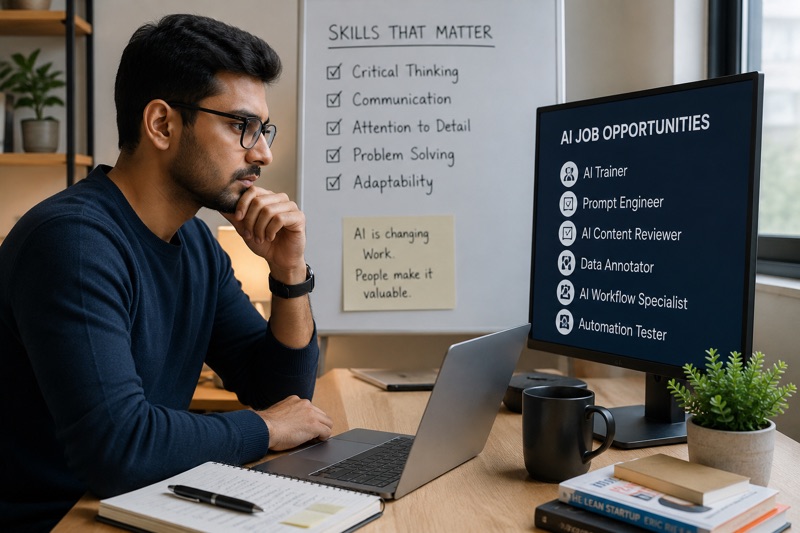
The Jobs AI Is Creating That Didn’t Exist A Few Years Ago

When people talk about AI and jobs, the conversation usually goes in one direction.

What jobs will AI replace?

It’s a fair question.

But while a lot of attention is focused on jobs that might disappear, something else is happening at the same time.

New roles are quietly appearing.

And some of them barely existed a few years ago.

I’ve noticed this myself while looking at job boards and AI-related opportunities online.

Not long ago, if someone told you there would be companies hiring people to train AI systems, review AI-generated content, test prompts, evaluate responses, or monitor automated workflows, it would have sounded unusual.

Today, those roles are becoming increasingly common.

Some companies now employ AI trainers whose job is to help improve how AI systems respond.

Others hire content reviewers to check AI-generated outputs for accuracy, safety, and quality.

There are also people working as AI annotators, helping label data so machine learning systems can better understand patterns.

What I find interesting is that many of these jobs don’t necessarily require someone to be a software engineer.

Of course, technical skills can help.

But some roles are built around something different.

The ability to:

  • communicate clearly
  • identify mistakes
  • follow processes
  • review information critically
  • and understand context

In other words, skills that humans have always valued.

That’s probably one of the biggest surprises for me.

The public conversation often makes AI sound like a technology that removes the need for people.

Yet many AI systems still depend heavily on human input behind the scenes.

Someone has to:

  • test the outputs
  • correct mistakes
  • review quality
  • provide feedback
  • and help improve performance over time

Without that, the systems don’t improve very effectively.

At the same time, there is another side to this discussion.

Not every “AI job” is as straightforward as it sounds.

I’ve seen plenty of job listings asking for AI experience while also expecting skills in areas like programming, automation, analytics, or digital marketing.

That can make the landscape confusing for people trying to enter the field.

The opportunity is there.

But so is the learning curve.

Perhaps that’s why the most valuable approach isn’t simply learning AI.

It’s learning how AI fits into existing skills.

A writer might use AI differently from an accountant.

A teacher might use it differently from a marketer.

A business owner might use it differently from a software developer.

The technology is the same.

The application changes.

And that’s where many of the newer opportunities seem to be emerging.

The more I look at it, the less AI feels like a completely separate industry.

In some ways, I find myself wondering how people reacted during the early stages of the Industrial Revolution.

Machines began changing how work was done. Some jobs became less important, new jobs appeared, and many people were uncertain about what the future would look like.

Looking back now, we often focus on the inventions themselves.

But for the people living through those changes, it was probably a period of uncertainty, adaptation, and learning.

The technologies are obviously very different.

But I sometimes wonder whether the concerns people had then are entirely different from the concerns people have about AI today.

Will it take jobs?

Will it create new ones?

Will people need new skills?

How much will work change?

These questions aren’t entirely new.

What’s different is the technology driving them.

It feels more like a layer being added across many industries at once.

Which may explain why we’re seeing new job titles appear so quickly.

Not because AI is replacing every role.

But because people are still needed to guide, evaluate, improve, and work alongside the technology.

And honestly, I suspect we’re only seeing the beginning of that process.


Curious — if someone had told you five years ago that “AI Trainer” would become a real job title, would you have believed them?


Sunday, 31 May 2026

Why AI Still Needs Human Verification


There’s a common assumption that as AI gets smarter, people will eventually be able to step back and let it do everything on its own.

The reality seems a lot more complicated.

AI has become remarkably good at generating text, analysing information, identifying patterns, and helping with tasks that would have taken much longer only a few years ago.

Yet something interesting keeps happening.

The more important the task becomes, the more humans are still expected to stay involved.

Take healthcare as an example.

AI can help analyse scans, identify potential abnormalities, and process huge amounts of medical data. But hospitals don’t simply hand over decision-making completely to a machine. Doctors still review results, consider the wider context, and make the final judgement.

The same thing happens in finance.

AI can detect unusual transactions, assess risk, and flag suspicious activity far faster than most humans could. Yet banks still rely on people to investigate, verify, and decide what action should be taken.

Even in cybersecurity, where AI is becoming increasingly powerful, human analysts remain a critical part of the process. Why?

Because AI is very good at recognising patterns.

But recognising patterns and understanding reality are not always the same thing.

A system might identify something as suspicious because it resembles a previous threat.

A person can look at the same situation and recognise that there are circumstances the system doesn’t fully understand.

This is one reason many organisations are adopting what is known as a “Human-in-the-Loop” approach.

The idea is fairly simple.

AI assists. Humans verify.

Instead of replacing human judgement, the technology becomes another layer in the decision-making process.

That balance is important because AI can still make mistakes.

Sometimes it lacks context.

Sometimes it misunderstands intent.

And occasionally it can present information with a level of confidence that makes it sound completely certain, even when it isn’t.

I’ve noticed this myself while experimenting with AI.

A response can look polished, structured, and convincing at first glance. Then after checking more carefully, you discover a detail is missing, a source was misunderstood, or an assumption has been made somewhere along the way.

The answer sounded right.

That didn’t automatically make it right.

And honestly, I think that’s one of the most important lessons people are learning as AI becomes part of everyday life.

The real skill may not be knowing how to use AI.

It may be knowing when to question it.

That doesn’t make AI less useful.

If anything, it highlights what it does best.

It can process huge amounts of information.

It can identify patterns.

It can speed up research.

It can help organise ideas.

But judgement, accountability, and responsibility still tend to sit with people.

At least for now.

Perhaps that’s why many experts aren’t building systems that remove humans entirely.

Instead, they’re building systems where humans and AI work together.

The machine handles the scale.

The human provides the oversight.

And when the stakes are high, that combination may be more powerful than either working alone.


If you missed the previous post, you can read it here: https://striv-striv.blogspot.com/


Curious — have you ever had AI give you an answer that sounded completely convincing, only to discover later that something wasn’t quite right?