Striv is a practical blog about making money online with AI, beginner-friendly tools, side hustles,

Sunday, 12 July 2026

Why I Don’t Want AI to Write My Books for Me

People often ask me whether I use AI.

The answer is yes.

I use it to research ideas, organise information, improve structure, and sometimes challenge my own thinking.

But when it comes to writing my novels, I see AI differently.

For me, a story is not just a collection of words arranged on a page.

It is imagination, emotion, personal experience, and the small details that make characters feel alive.

Could AI create a story?

Yes.

Could it help develop a strong plot, interesting characters, and a clear structure?

Absolutely.

But would it tell my story?

That is where I believe the difference begins.

Writing a novel is not only about reaching the final chapter. It is about every choice made along the way.

The conversation a character has that reveals something unexpected.

The idea that appears while writing a scene.

The moment when a chapter feels wrong and needs to be rewritten.

Those decisions come from the writer’s perspective, experiences, and understanding of people.

That is the part I want to protect.

This does not mean AI has no role in creativity.

It does.

I have found it useful for brainstorming, checking clarity, exploring different approaches, and questioning ideas I may have overlooked.

AI has become another tool on my desk.

But it is not the author sitting in my chair.

The balance for me is simple:

Use technology where it adds value.

Keep the creative decisions where they belong.

As AI continues to develop, more writers will face an important question.

Not whether AI can write a book.

But how much of the creative process they are willing to hand over.

For me, the answer is clear.

I want readers to connect with my ideas, my characters, and my voice.

AI can help me improve as a writer.

But it cannot replace the experiences, memories, and emotions that inspired me to write.

And that is something I hope never changes.


Wednesday, 8 July 2026

AI Under the Microscope: Can AI Really Replace Software Developers?


Every few weeks, another headline appears claiming that AI is about to replace software developers.

Some predict businesses will soon need far fewer programmers.

Others argue that software will eventually be built almost entirely by AI.

It’s an eye-catching claim.

But does it reflect what’s actually happening?

The more I read about it, the more I think the answer is more nuanced than the headlines suggest.

There’s no doubt that AI is changing software development.

Today’s AI tools can generate code, explain programming concepts, identify bugs, suggest improvements, and even help write documentation.

For repetitive tasks, that can save developers a considerable amount of time.

But writing code is only one part of building software.

A typical project also involves:

  • understanding what a client actually needs
  • designing the overall architecture
  • testing ideas
  • solving unexpected problems
  • reviewing code
  • strengthening security
  • maintaining existing systems

None of those tasks begins with code.

They begin with understanding the problem.

That’s an important distinction.

Software development has never been just about typing lines of code.

It’s about analysing situations, making decisions, and finding practical solutions.

AI can certainly assist with that process.

But assistance isn’t the same as replacement.

Across the technology industry, developers are increasingly using AI as another tool in their workflow. In many teams, it’s helping speed up routine tasks while people continue making the technical and architectural decisions.

That pattern feels familiar.

When calculators became widely available, mathematicians didn’t disappear.

When spreadsheets transformed accounting, accountants didn’t suddenly become obsolete.

The tools changed.

The professions evolved alongside them.

AI may be following a similar path.

Routine coding tasks will almost certainly become more automated.

But software still needs people who understand users, business requirements, security, reliability, and the countless decisions that happen long before the first line of code is written.

Personally, I think we’ve been asking the wrong question.

Instead of asking:

Can AI write code?

Perhaps we should be asking:

Can AI fully understand the problem the software is supposed to solve?

At least for now, that still depends heavily on human judgement.

So perhaps the future isn’t AI versus software developers.

Perhaps it’s software developers who know how to work effectively with AI.

And that may prove to be one of the profession’s most valuable skills.


💬 What do you think?

Will AI eventually replace software developers, or will it simply become another tool that changes how they work?


Sunday, 5 July 2026

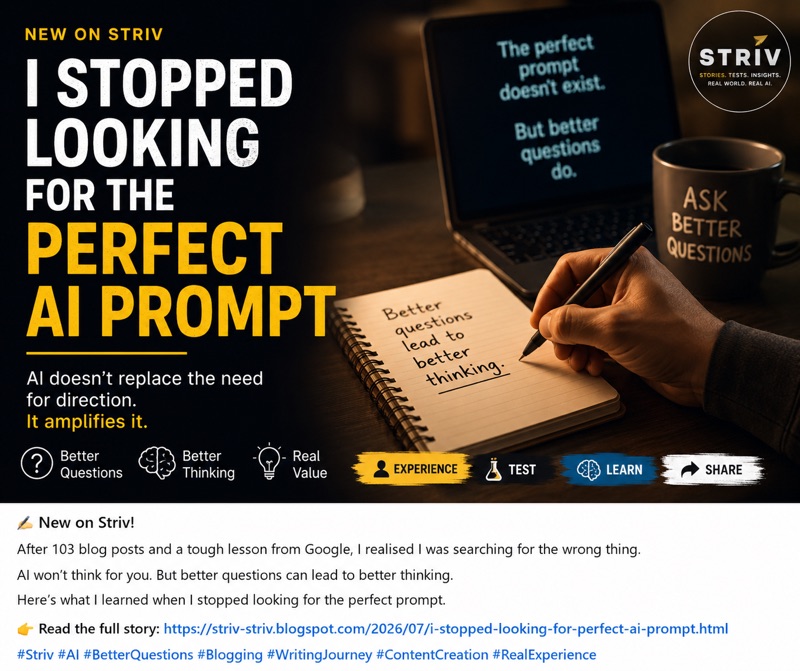
​I Stopped Looking for the Perfect AI Prompt


By Chet Oji

Yesterday, I shared one of the most frustrating moments I’ve had since starting this blog.

After publishing 103 posts, Google AdSense rejected my site with the words “Low value content.”

I spent nearly two hours asking AI to help me find the perfect blog post that would finally change Google’s mind.

It never came.

When I woke up the next morning, I realised something else.

Maybe I wasn’t looking for the perfect blog post.

Maybe I was looking for the perfect prompt.

Like many people discovering AI, I’ve often believed that somewhere out there is a magical prompt that unlocks extraordinary results.

A prompt that writes the perfect article.

A prompt that builds the perfect business.

A prompt that guarantees AdSense approval.

The more I thought about it, the more I realised how unrealistic that expectation is.

AI doesn’t replace the need for direction.

It amplifies it.

If I don’t know what I’m trying to achieve, no prompt can solve that problem for me.

It’s a bit like giving someone the world’s best sat-nav but never telling it the destination.

The technology isn’t broken.

The journey simply hasn’t been defined.

That thought stayed with me throughout the day.

For months I’ve been asking AI questions like:

“What should I write today?”

Perhaps the better question is:

“What have I experienced today that someone else could learn from?”

Those two questions lead to completely different articles.

The first asks AI to invent.

The second asks AI to help communicate something that’s already real.

That doesn’t just apply to blogging.

It applies to work.

To business.

To learning.

To creativity.

AI can help us organise ideas, improve clarity and explore possibilities.

But it still needs something deeply human to work with.

Curiosity.

Experience.

Purpose.

Without those, even the most advanced AI has very little to build on.

Ironically, I think Google’s rejection taught me something that AI couldn’t.

Value doesn’t come from producing more content.

It comes from having something worth saying.

I’m still learning what Striv should become.

I don’t have all the answers yet.

But I know this much.

From today, I’ll spend less time searching for perfect prompts…

…and more time asking better questions.

Because better questions don’t just produce better AI responses.

They produce better thinking.

And perhaps that’s where real value begins.


What about you?

Have you ever spent more time looking for the perfect tool than defining the problem you were trying to solve?

I’d genuinely like to hear your thoughts in the comments.


Friday, 3 July 2026

103 Posts Later: Why Google Still Said My Blog Had ‘Low Value Content’

By Chet Oji

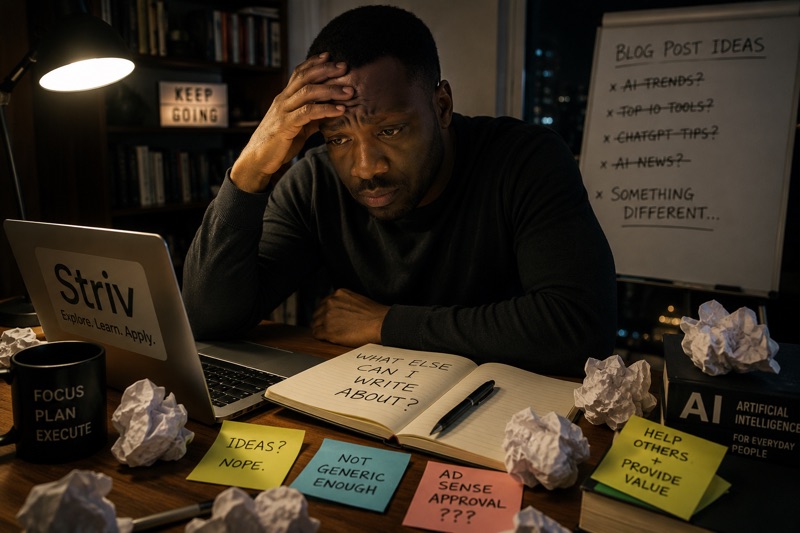
It was 11 p.m. after a very busy day at work, I sat in the bathroom with my phone in my hand, convinced that somewhere there had to be the perfect blog post that would finally get readers engaged.

Two hours later, I hadn’t found it.

What I found instead was something much more valuable.

After publishing 103 blog posts, I received the message from google Adsense every blogger dreads:

“Low value content.”

I stared at those three words wondering how they could possibly apply to a blog I’d spent months building.

How could 103 articles be considered low value?

Was my writing really that poor?

Had I misunderstood what represents engagement in reading?

Or was I chasing the wrong goal altogether?

For the next two hours, I did what many of us do when we feel stuck.

I asked AI.

Again.

And again.

Every new idea sounded promising for a few minutes before turning into another article that felt… ordinary.

“Top AI trends…”

“How AI is changing…”

“Five ways AI can help…”

I realised something uncomfortable.

I wasn’t struggling because AI couldn’t write.

I was struggling because I didn’t know what was truly worth writing.

That’s a very different problem.

For weeks, I’d been asking AI to find the perfect topic.

Looking back, that was never a question AI could answer for me.

AI can organise ideas.

It can improve writing.

It can explain complex subjects.

But it cannot tell me what matters to me.

Only I can do that.

This very night, I stopped blaming the technology.

The problem wasn’t ChatGPT.

The problem wasn’t google AdSense.

The problem was that I was expecting a tool to provide clarity that I hadn’t yet found myself.

That realisation changed how I think about this blog.

Maybe Striv doesn’t need another article explaining what AI is doing.

Maybe it needs more articles explaining what it’s like to actually live, work, create, fail, and learn alongside AI.

After all, no one else has my journey.

No one else spent months brainstorming novels ideas with AI as an assistant.

No one else built this exact blog, published 103 posts, and then had Google say they still weren’t valuable enough.

That’s my experience.

And perhaps that’s the value I’ve been overlooking all along.

This article probably won’t be perfect.

It probably won’t instantly impress AdSense either.

But it’s the most honest thing I’ve written in a long time.

Instead of asking AI to think for me, I’m learning to use it to think with me.

Maybe that’s the lesson I should have understood from the beginning.

The next chapter of Striv won’t be about chasing perfect articles.

It will be about sharing real experiences, asking better questions, and learning in public.

If that eventually leads to AdSense approval, I’ll be delighted.

But even if it doesn’t, at least I’ll know the words on this page are genuinely mine.


Have you ever spent hours searching for the perfect answer, only to realise you were asking the wrong question? I’d love to hear your experience in the comment.