
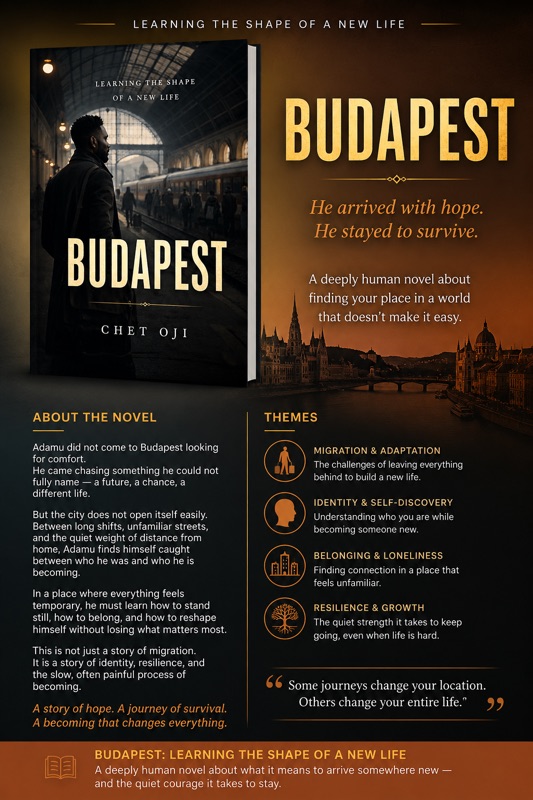
At first glance, Budapest may seem like a story about someone moving to a new country in search of a better life.
But honestly, the deeper I thought about the story, the more I realised it was never only about migration itself.
It’s more about what happens internally when someone leaves behind familiarity and steps into a life that no longer feels fully connected to who they used to be.
Adamu arrives in Budapest carrying hope.
Not necessarily a perfect plan. Not certainty. Not comfort.
Just hope that somewhere ahead, life might become different.
And I think that’s something many people quietly understand, even outside migration itself.
The experience of entering unfamiliar territory, trying to adapt, trying to survive, and slowly realising that change affects you emotionally as much as physically.
What interested me most about the story was not dramatic events.
It was the quieter realities:
- long shifts
- unfamiliar streets
- emotional distance from home
- isolation
- uncertainty
- and the slow pressure of trying to rebuild yourself in a place that doesn’t automatically make room for you
Because sometimes survival is not loud.
Sometimes survival looks like continuing anyway.
That became one of the emotional foundations of Budapest.
Adamu’s journey is not simply about arriving in another country.
It’s about identity.
About trying to figure out:
- who you are becoming
- what parts of yourself you hold onto
- and how much change a person can go through before they begin feeling unfamiliar even to themselves
And honestly, I think many people experience versions of that feeling in different ways throughout life.
You don’t always need to cross borders physically to understand emotional displacement.
Sometimes life itself places people in unfamiliar emotional territory.
That’s also why I wanted the story to feel human first before anything else.
Not exaggerated. Not overly dramatic.
Just emotionally honest.
Because behind many migration stories are ordinary people carrying invisible emotional weight while trying to continue functioning normally.
People adapting quietly.
Missing home quietly.
Struggling quietly.
Growing quietly.
And often, nobody fully sees that process from the outside.
For me, Budapest became a story about resilience in its most human form.
Not perfection.
Not instant transformation.
Just the difficult, gradual process of learning how to build a new life while trying not to lose yourself completely along the way.
If Budapest resonates with you — especially themes of identity, migration, resilience, and starting over in unfamiliar places — you can explore the novel here: https://shorturl.at/yPTTM
Sometimes the hardest journeys are not the loudest ones. They may happen quietly, while someone is simply trying to build a new life.


No comments:
Post a Comment