
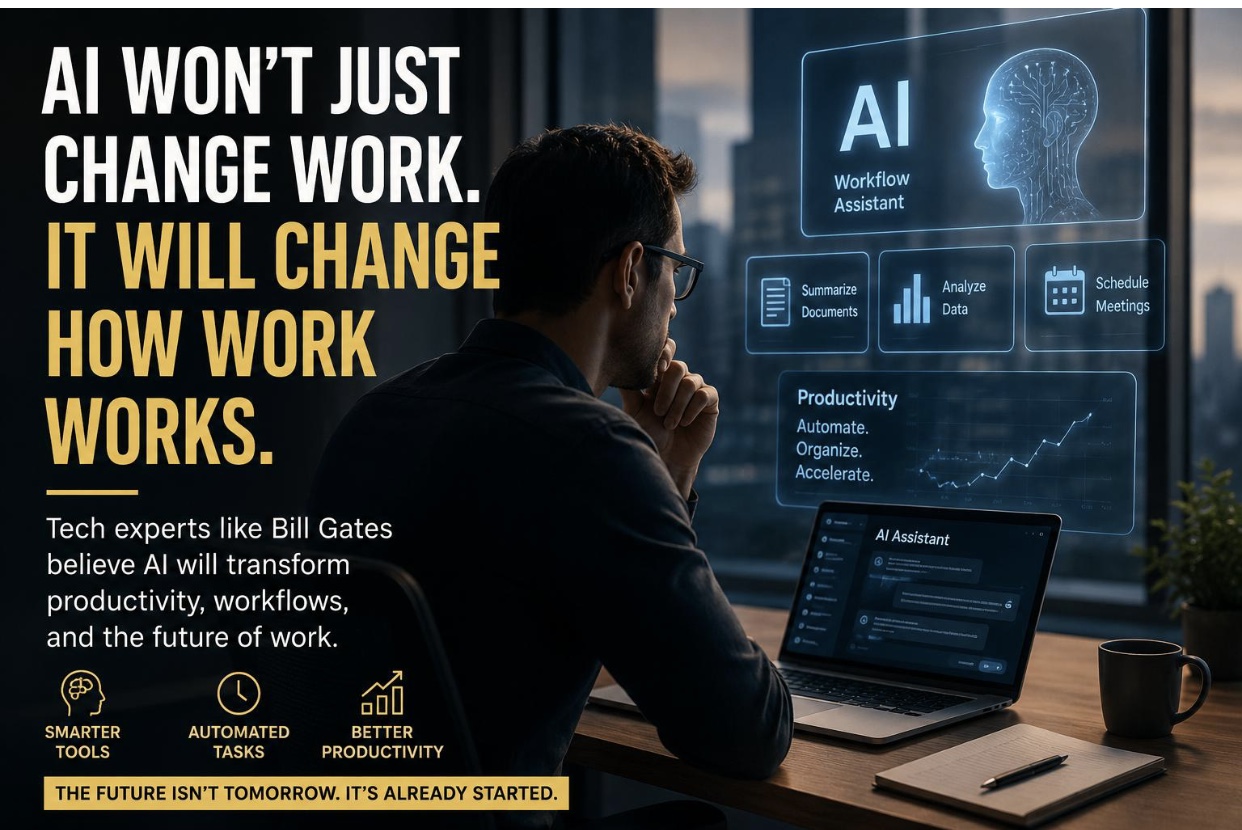
The more I read different opinions about AI, the more I notice something interesting.
Even people who are optimistic about AI still seem to agree on one thing:
Work is going to change.
One person who has spoken about this quite a lot recently is Bill Gates.
Over the last year, Gates has repeatedly shared his view on how AI could eventually transform large parts of modern work, healthcare, and education. He believes AI systems may one day handle many repetitive and knowledge-based tasks that currently require human workers. (https://shorturl.at/LLH2F)
And honestly, I think what makes his perspective interesting is that he doesn’t always describe AI as simply “taking jobs.”
He often talks more about AI changing how human work functions altogether.
That’s an important difference. Because when people hear discussions about AI, the conversation usually becomes very extreme very quickly.
Either: - “AI will replace everyone” or - “AI is completely overhyped” But reality probably sits somewhere in the middle.
For example, Gates has suggested that AI could eventually reduce shortages in areas like healthcare and education by helping provide medical guidance, tutoring, and administrative support at scale. (https://shorturl.at/ioJ0V)
At the same time, he has also acknowledged that AI may significantly reduce the need for humans in certain types of repetitive digital work over time. (https://shorturl.at/kB8nv)
I personally think a lot of people are already starting to see small signs of this shift happening now.
AI is increasingly being used to:
-summarise meetings
- draft documents - organise schedules
- analyse information
- answer customer questions
- assist with research
- and automate repetitive online tasks
Not perfectly. Not independently. But enough to noticeably speed things up.
What’s interesting is that this doesn’t always remove humans from the process completely.
Instead, it often changes the role humans play within the workflow.
Someone who once spent hours organising information manually may now spend more time:
- reviewing
- editing
- supervising
- refining
- or making decisions based on AI-assisted output
That changes the nature of productivity itself. And honestly, I think this is where the conversation becomes more realistic and less dramatic.
This is because historically, technology has usually changed workplace gradually rather than replacing entire industries overnight.
Computers changed offices. The internet changed communication. Smartphones changed our everyday life.
AI may simply become the next major layer added on top of modern work environments.
At the same time, I also think there’s a risk in assuming AI automatically solves everything.
Because even advanced systems still:
- make mistakes
- misunderstand context
- produce inaccurate information
- and require human judgement
So while AI may improve efficiency, people will probably still matter enormously in areas involving:
- trust
- creativity
- emotional understanding
- leadership
- and real-world decision making
One thing I do find interesting about Gates’ perspective is that he often talks about AI creating more abundance rather than just the fear factor.
He has even suggested that AI could eventually reduce working hours significantly in the future because machines may handle larger parts of production and digital work. (https://shorturl.at/Utf0b )
Whether that actually happens or not remains to be seen. But I think the bigger point is this: AI is no longer just a technology discussion.
It’s becoming a discussion about:
- how humans work
- how societies adapt
- how productivity changes
- and what role people continue playing in increasingly automated environments
And honestly, I think we’re still only at the beginning of figuring that out.
If you missed the previous post, you can read it here: https://striv-striv.blogspot.com/
Do you think AI will mainly improve human work… or eventually reduce the need for many jobs altogether?

