
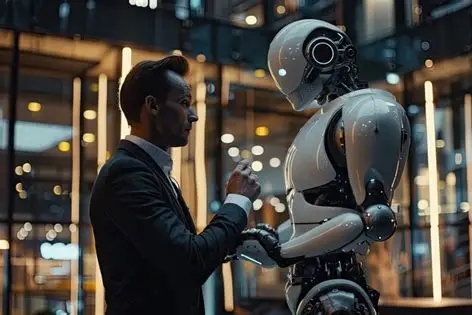
Something unusual has started happening over the last couple of years.
People are no longer just “using” AI.
They’re talking to it.
Not in a robotic or technical way either. In many cases, people now interact with AI almost the same way they would interact with another person. They ask questions conversationally, explain situations in detail, say “thank you,” and sometimes even share frustrations or emotions while using it.
And strangely enough, the responses can feel surprisingly natural.
That raises an interesting question:
Why does AI sometimes feel so human?
The answer is partly because modern AI systems have become extremely good at recognising language patterns. They are trained on enormous amounts of human writing and conversation, which allows them to respond in ways that sound familiar, structured, and emotionally aware.
If you ask a serious question, the tone often becomes calm and thoughtful.
If you ask casually, the response usually feels lighter and more conversational.
If you sound frustrated, the system often adjusts its tone again.
That adaptability is one reason many people feel unusually comfortable talking to AI.
But there’s another reason too.
AI responds instantly.
No waiting. No judgement. No embarrassment about asking “stupid” questions.
For many people, that changes the experience completely.
Someone struggling with technology might ask AI how to send files or improve photos. A student might use it to simplify a difficult topic. A business owner might use it to brainstorm ideas or rewrite content more professionally.
In each case, the interaction can feel surprisingly personal — not because AI truly understands emotions, but because it has become very good at responding in a human-like way.
And honestly, that can be both impressive and slightly unsettling at the same time.
Because although AI sounds human, it’s important to remember that it doesn’t actually think or feel in the way people do.
It doesn’t have personal experiences. It doesn’t understand relationships, grief, happiness, fear, or love the way human beings understand them. What it does is recognise patterns in language and predict responses that statistically fit the conversation.
In simple terms, AI is extremely advanced pattern recognition.
But here’s the fascinating part:
Even knowing that, many people still naturally respond to AI as if there’s some level of personality behind it.
You can already see this happening online.
People joke with AI. Thank it. Argue with it. Test it. Some even admit they find it easier asking AI certain questions because they feel less judged.
That says something interesting not just about technology — but about human behaviour too.
We naturally connect with things that communicate in familiar ways.
And AI is increasingly designed to feel familiar.
At the same time, this is where balance becomes important.
Because while AI can be helpful, informative, and even comforting in some situations, it still has limitations.
It can confidently give incorrect answers. It can misunderstand context. It can sound certain while being completely wrong.
That’s why AI works best as a tool that supports human thinking, not replaces it.
Personally, I think this is where the conversation around AI becomes more interesting than the usual “AI will take over the world” headlines.
The real shift isn’t robots replacing people overnight.
The real shift is that human beings are beginning to interact with software in much more natural and emotional ways than ever before.
And that changes how people experience technology altogether.
For years, technology felt mechanical.
You clicked buttons. Typed commands. Followed menus.
Now, increasingly, people simply talk.
That’s a major shift in itself.
Children are growing up speaking naturally to devices. Adults are asking AI to explain, summarise, organise, create, and guide them through tasks in plain language.
Technology is becoming conversational.
And because of that, AI is starting to feel less like a machine and more like an assistant quietly sitting in the background of daily life.
Whether that becomes entirely positive or not probably depends on how responsibly people use it.
Used well, AI can:
- improve productivity
- help people learn faster
- reduce frustration
- simplify complicated tasks
- support creativity
But people still need critical thinking, judgement, and real human connection.
Because no matter how advanced AI becomes, there are still parts of human experience that go beyond predicting words on a screen.
Empathy.
Presence.
Shared experience.
Genuine understanding.
Those things still matter.
And perhaps that’s the most important balance to remember as AI becomes more integrated into everyday life.
Not fearing it blindly.
Not trusting it blindly either.
But understanding what it really is:
a powerful tool designed to communicate in increasingly human ways.
If you missed the previous post, you can read it here:
👉 https://shorturl.at/9oMQH
If you need help understanding AI tools or want simple prompts to get started, feel free to message me — I’ll respond as soon as I can 👍
Curious — have you ever caught yourself talking to AI almost like it was a real person?

