
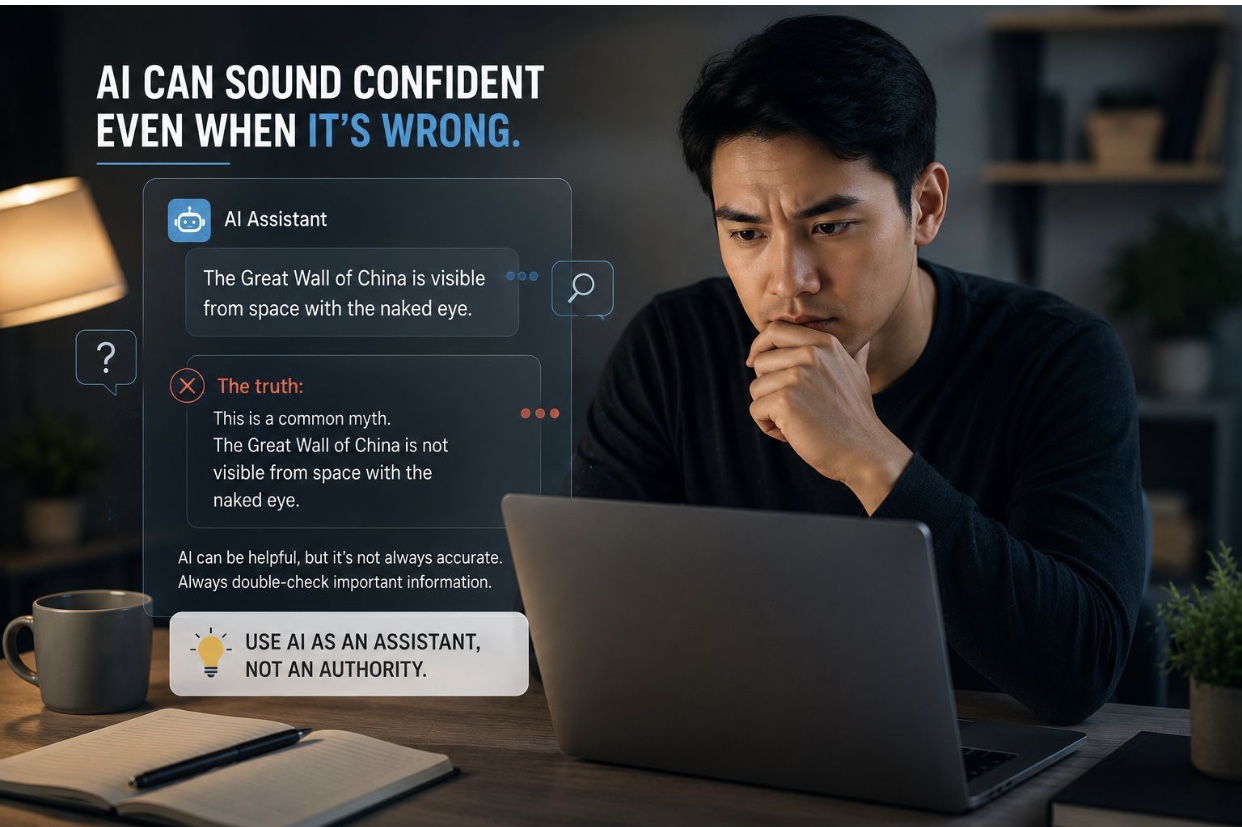
The more I use AI, the more I’ve started noticing something interesting.
Sometimes the biggest problem isn’t that AI gives bad answers.
It’s that it can give answers that are incorrect very confidently.
And honestly, that can be surprisingly misleading.
I asked AI something fairly simple that I already roughly understood.
The response came back quickly.
Well written.
Structured.
Confident.
At first glance, it looked completely fine.
But after reading more carefully, I noticed small issues:
- missing context
- slightly inaccurate details
- and a few assumptions that weren’t entirely correct
Nothing dramatic.But enough to realise something important:
AI can sound more certain than it should.
And I think that’s one of the most relatable flaws people should begin to observe.
Because when humans are unsure about something, we tend hesitate before answering.
People say things like:
- “I think…”
- “I’m not completely sure…”
- “You may want to double-check that…”
AI may not do that naturally.
Sometimes it presents information very smoothly, even when parts of the answer are incomplete or inaccurate.
That can create a strange illusion of reliability.
Especially because modern AI writes so naturally now.
The wording sounds polished.
The tone sounds intelligent.
The structure feels convincing.
So it becomes easy to assume:
“If it sounds this confident, it must be correct.”
But that’s not always true.
And honestly, I think many people only fully realise this after using AI repeatedly themselves.
You start learning that:
- first answers are not always the best answers
- context matters enormously
- prompts influence quality
- and occasionally, AI simply gets things wrong
What’s interesting is that this doesn’t necessarily make AI useless.
In many cases, it’s still extremely helpful for:
- brainstorming
- simplifying information
- organising ideas
- improving writing
- summarising topics
- or speeding up research
But it does make you think on how you use it.
Instead of treating AI like an all-knowing system, you begin treating it more like:
a very fast assistant that still needs supervision.
And honestly, that feels like a healthier way to approach it.
Not fear. Not blind trust either.
Just understanding both the usefulness…
and the limitations at the same time.
Because the more human AI sounds,
the easier it becomes to forget that it can still make very non-human mistakes.
And perhaps learning that balance is becoming one of the most important parts of using AI well.
---
Just curious-have you ever had AI give you an answer that sounded convincing at first… but later turned out to be inaccurate?


No comments:
Post a Comment