
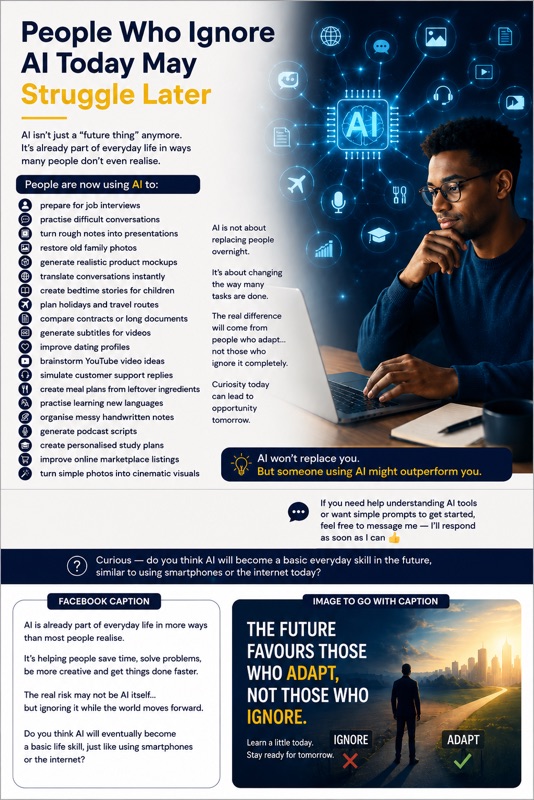
A few years ago, many people treated AI like a futuristic idea.
Something interesting…
but distant.
Now it’s quietly becoming part of everyday life much faster than many expected.
People are now using AI to:
- prepare for job interviews
- practise difficult conversations
- turn rough notes into presentations
- restore old family photos
- generate realistic product mockups
- translate conversations instantly
- create bedtime stories for children
- plan holidays and travel routes
- compare contracts or long documents
- generate subtitles for videos
- improve dating profiles
- brainstorm YouTube video ideas
- simulate customer support replies
- create meal plans from leftover ingredients
- practise learning new languages
- organise messy handwritten notes
- generate podcast scripts
- create personalised study plans
- improve online marketplace listings
- turn simple photos into cinematic visuals
And increasingly, workplaces are starting to notice who understands these tools — and who doesn’t.
That doesn’t necessarily mean AI will replace everyone.
But it may slowly replace certain ways of working.
And honestly, I think that’s the part many people still underestimate.
Because historically, major technology shifts rarely happen all at once.
They happen gradually.
At first:
only curious people experiment with them.
Then businesses adopt them quietly.
Eventually:
people who ignored the change completely start finding themselves behind.
We’ve seen this before with:
- computers
- smartphones
- the internet
- social media
- online banking
- digital communication
At one point, many people dismissed those things too.
Now they’re considered normal parts of modern life.
AI may follow a similar path.
What’s interesting is that AI is not only affecting technical industries.
It’s spreading into ordinary everyday work surprisingly fast.
For example:
someone who understands AI-assisted workflows may complete certain tasks in half the time.
A content creator may produce ideas faster.
A small business owner may market products more efficiently.
A student may learn difficult concepts more quickly.
An office worker may automate repetitive admin tasks.
That creates a new kind of advantage.
Not necessarily because the person is “more intelligent”…
but because they’re learning how to work alongside modern tools more effectively.
And honestly, I think this is where the AI conversation becomes more practical than dramatic.
The biggest shift may not be robots replacing humans overnight.
The bigger shift may simply be:
people who adapt becoming more efficient than people who refuse to adapt at all.
That already seems to be happening.
At the same time, I don’t think people need to panic or suddenly become technology experts.
Most people using AI productively today are not programmers.
They’re ordinary people learning small practical ways to:
- save time
- improve workflow
- reduce frustration
- communicate more clearly
- create faster
And perhaps that’s the smartest way to approach AI right now.
Not fear.
Not blind trust either.
But curiosity.
Because ignoring technology completely has rarely worked well long-term.
Especially when that technology starts becoming integrated into:
- jobs
- education
- communication
- business
- entertainment
- and daily productivity
Personally, I think one of the biggest mistakes people can make today is assuming AI only matters to “tech people.”
Increasingly, it’s becoming relevant to almost everyone.
And the gap between people who adapt early…
and people who ignore it completely…
may become more noticeable over the next few years.
---
If you missed the previous post, you can read it here:


No comments:
Post a Comment