
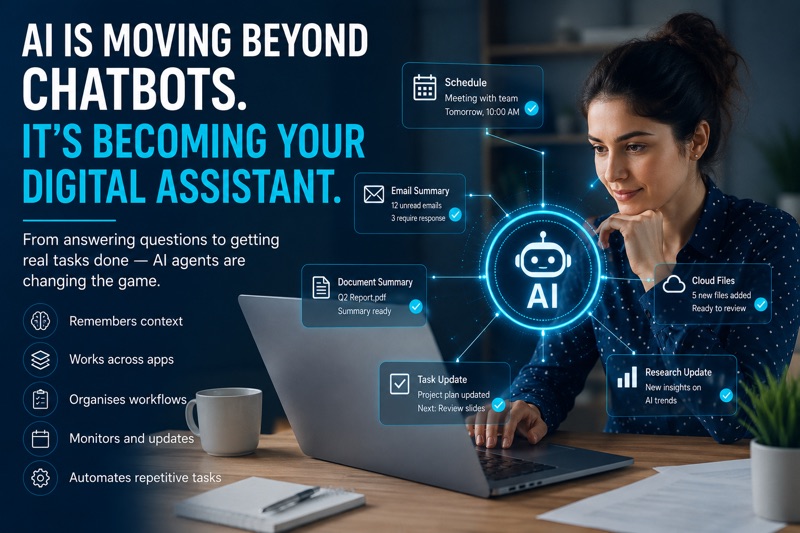
For a while, we viewed AI as something fairly simple.
It mainly answered questions.
That was the experience many of us became familiar with over the last couple of years.
But this week, one of the biggest conversations in AI has been about something much larger beginning to happen behind the scenes:
AI is slowly evolving from “answering questions” to actually helping complete tasks. (The Verge)
And honestly, I don’t think most people fully realise how important that shift could become.
The newer generation of AI tools are increasingly being designed to:
- remember context
- organise information
- work across apps
- monitor tasks
- assist with research
- automate repetitive workflows
Instead of acting like a search box, AI is starting to behave more like a digital assistant.
For example, some newer systems can already:
- summarise emails while checking calendars
- organise notes across multiple documents
- monitor topics and provide updates automatically
- assist with scheduling and online tasks
- help manage long workflows instead of single prompts
That may sound small at first.
But it changes the role AI plays completely.
One example announced this week is how search platforms are becoming more “interactive” rather than simply displaying links. Some AI systems are beginning to:
- understand longer requests
- work with uploaded files
- connect with apps
- and maintain ongoing task context during conversations (The Verge)
In simple terms:
AI is slowly becoming less like a tool you occasionally use…
and more like a system that quietly assists in the background.
Another interesting shift is something called “AI agents.”
That term is appearing everywhere right now in technology discussions.
The idea behind AI agents is that instead of waiting for one instruction at a time, the system can handle multi-step tasks more independently.
For example:
instead of asking AI five separate questions to complete something…
you might eventually say:
“Help me organise this project, summarise the documents, create a presentation, and remind me about unfinished sections.”
And the system handles much more of the process automatically.
That’s a very different experience from early chatbots.
At the same time, this doesn’t mean AI suddenly becomes magical or perfect.
These systems still make mistakes.
They still require supervision.
And there are growing concerns around:
- privacy
- misinformation
- overreliance
- automation replacing certain tasks
- and how much people should trust AI-generated outputs
So while the technology is improving quickly, human judgement still matters enormously.
Personally, I think this is the stage where AI starts becoming genuinely practical for ordinary people.
Not because it’s replacing human intelligence…
but because it’s beginning to reduce friction in everyday digital tasks.
That’s probably why so many companies are now racing to integrate AI deeper into:
- search
- messaging
- productivity tools
- browsers
- phones
- business software
- and online workflows
The competition is no longer just about who has the “smartest chatbot.”
It’s becoming about who builds the most useful assistant for everyday life.
And honestly, that shift may end up changing how people use technology more than many expect.
Because for years, humans adapted themselves to software.
Now increasingly…
software is adapting itself to humans.
---
If you missed the previous post, you can read it here:
---
Curious — would you actually trust AI to handle real tasks for you automatically, or do you still prefer staying fully in control yourself?


No comments:
Post a Comment