
When people talk about AI and jobs, the conversation usually goes in one direction.
What jobs will AI replace?
It’s a fair question.
But while a lot of attention is focused on jobs that might disappear, something else is happening at the same time.
New roles are quietly appearing.
And some of them barely existed a few years ago.
I’ve noticed this myself while looking at job boards and AI-related opportunities online.
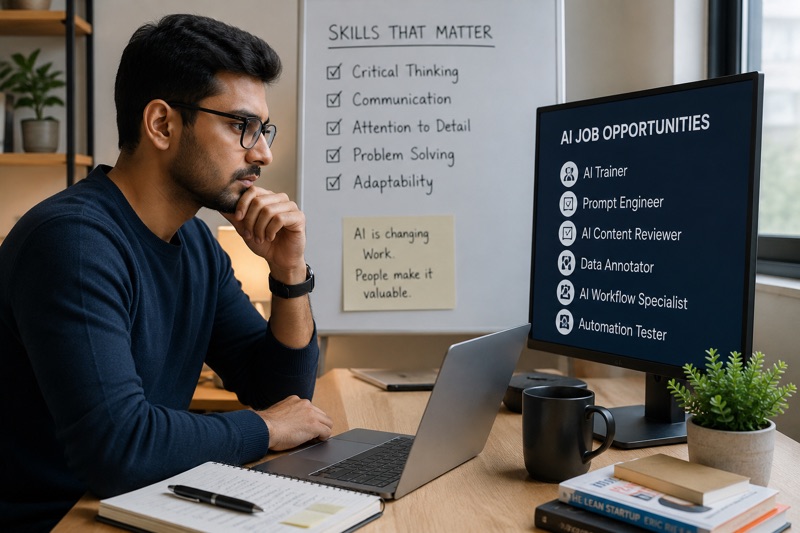
Not long ago, if someone told you there would be companies hiring people to train AI systems, review AI-generated content, test prompts, evaluate responses, or monitor automated workflows, it would have sounded unusual.
Today, those roles are becoming increasingly common.
Some companies now employ AI trainers whose job is to help improve how AI systems respond.
Others hire content reviewers to check AI-generated outputs for accuracy, safety, and quality.
There are also people working as AI annotators, helping label data so machine learning systems can better understand patterns.
What I find interesting is that many of these jobs don’t necessarily require someone to be a software engineer.
Of course, technical skills can help.
But some roles are built around something different.
The ability to:
- communicate clearly
- identify mistakes
- follow processes
- review information critically
- and understand context
In other words, skills that humans have always valued.
That’s probably one of the biggest surprises for me.
The public conversation often makes AI sound like a technology that removes the need for people.
Yet many AI systems still depend heavily on human input behind the scenes.
Someone has to:
- test the outputs
- correct mistakes
- review quality
- provide feedback
- and help improve performance over time
Without that, the systems don’t improve very effectively.
At the same time, there is another side to this discussion.
Not every “AI job” is as straightforward as it sounds.
I’ve seen plenty of job listings asking for AI experience while also expecting skills in areas like programming, automation, analytics, or digital marketing.
That can make the landscape confusing for people trying to enter the field.
The opportunity is there.
But so is the learning curve.
Perhaps that’s why the most valuable approach isn’t simply learning AI.
It’s learning how AI fits into existing skills.
A writer might use AI differently from an accountant.
A teacher might use it differently from a marketer.
A business owner might use it differently from a software developer.
The technology is the same.
The application changes.
And that’s where many of the newer opportunities seem to be emerging.
The more I look at it, the less AI feels like a completely separate industry.
In some ways, I find myself wondering how people reacted during the early stages of the Industrial Revolution.
Machines began changing how work was done. Some jobs became less important, new jobs appeared, and many people were uncertain about what the future would look like.
Looking back now, we often focus on the inventions themselves.
But for the people living through those changes, it was probably a period of uncertainty, adaptation, and learning.
The technologies are obviously very different.
But I sometimes wonder whether the concerns people had then are entirely different from the concerns people have about AI today.
Will it take jobs?
Will it create new ones?
Will people need new skills?
How much will work change?
These questions aren’t entirely new.
What’s different is the technology driving them.
It feels more like a layer being added across many industries at once.
Which may explain why we’re seeing new job titles appear so quickly.
Not because AI is replacing every role.
But because people are still needed to guide, evaluate, improve, and work alongside the technology.
And honestly, I suspect we’re only seeing the beginning of that process.
Curious — if someone had told you five years ago that “AI Trainer” would become a real job title, would you have believed them?


No comments:
Post a Comment